
What's Actually Happening
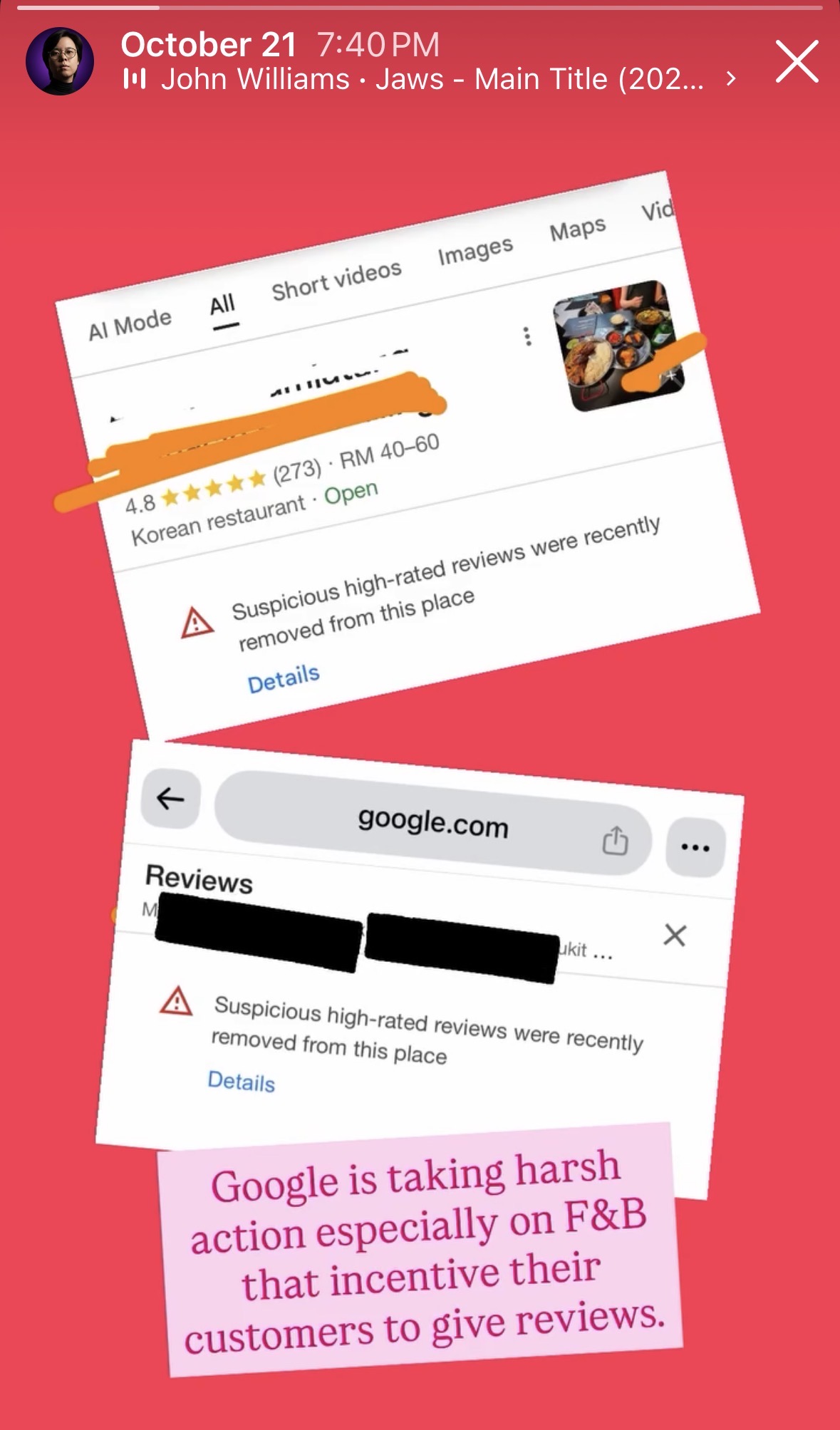
Google's review detection system has changed. It's no longer just checking whether a review is genuine. It's checking how it was collected, when it was collected, and what pattern it forms alongside other reviews on your profile.
This is affecting businesses across every industry. Not just F&B. Not just businesses buying fake reviews.
Roofers. Law firms. Training companies. Consultants. Clinics. E-commerce brands. Anyone actively building their Google presence.
And here's the part that stings most:
Reviews you collected months or years ago can now be removed retroactively if they match patterns Google's AI has newly identified as suspicious.
The purge isn't just forward-looking. It goes backwards too.
The 5 Patterns Getting Businesses Flagged Right Now
Pattern 1: The Burst
A sudden spike of reviews in a short window, especially after months of low activity. If your baseline is 2 reviews a month and you suddenly get 20 in one week, Google treats it as an unnatural pattern.
Pattern 2: The On-Premises Cluster
Multiple reviews left from the same location, same wifi signal, same time. Common with QR codes at counters, on tables, or on receipts. Looks coordinated even when it isn't.
Pattern 3: The Staff Name Signal
Reviews that mention specific staff members by name, especially when your team has been trained to ask customers to do so. Google's policy specifically flags this as solicited, directed content.
Pattern 4: The Reward Trigger
A customer answering "yes" to Google's own prompt asking if your business offers rewards in exchange for reviews. Even a confused or mistaken click can trigger a review sweep.
Pattern 5: The Database Blast
Sending a review request to your entire client or customer database at once via WhatsApp, email or SMS. Even if every recipient genuinely had a great experience, the volume spike looks manipulated.
The fixes
Fix 1. Change where your QR code points
Linking QR codes directly to the Google review submission window triggers bot detection, requiring a shift to using the main Business Profile link for organic engagement.
How to do it:
Instead, link your QR code to a branded Google search. The customer scans it, it opens a regular Google search screen, they click your profile, and click write a review. This extra step mimics natural consumer behavior ("organic search signals"), which tricks the AI into believing the user found you naturally rather than being pressured at a counter
Fix 2. Ask after they leave, not while they're there
Google's systems flag on-premises review patterns. When reviews come from inside your physical location in volume, the algorithm treats it as pressure-driven solicitation.
Send your review request after the customer or client has left. Give themtime to process their experience, then reach out.
Timing guide by industry:
- F&B and retail: 2 to 4 hours after they leave
- Clinics and wellness: same evening or next morning
- Training and workshops: 24 to 48 hours after the session ends, not during or immediately after
- B2B services: after project completion or a key milestone, not mid-engagement
- E-commerce: 3 to 5 days after delivery is confirmed
Fix 3. Space out your asks
Consistent beats burst, every time. Build a steady review cadence rather than running campaigns.
Not 50 in one week and nothing for two months. If your baseline activity suddenly spikes out of nowhere, Google treats it as an unnatural pattern.
For businesses with a large existing client base, segment your outreach and drip it over 4 to 6 weeks instead of blasting everyone at once.
How many reviews are safe? Match your transaction volume:
- For B2B & High-Ticket Services: Aim for 1 to 3 reviews per week. Low-transaction businesses naturally receive fewer reviews.
- For F&B, Retail & E-commerce: Aim for 10 to 30 reviews per week. High-volume transactions justify a higher, steady flow.
- The Competitor Rule: Look at your top 3 local competitors. Match their average monthly review growth to stay safely under the AI radar.
⚠️ The Golden Rule: Google's AI flags the sudden pattern change, not the high count itself. Match your top 3 local competitors' monthly growth to stay safely under the radar.
Fix 4. Mix your channels
Relying on one single collection method creates a pattern. Mix your review request channels so reviews arrive from different devices, sources, and times.
Suggested channel mix:
- Organic QR code: Displayed in-store, but points to a branded Google search, never a direct link.
- SMS follow-up: Sent 2 to 4 hours after delivery or departure (best for F&B and retail).
- Email follow-up: Dispatched the next morning alongside an invoice or receipt.
- WhatsApp message: Sent to B2B clients directly after a project milestone wrap.
- Verbal ask: Mentioned on-site, with a digital follow-up link texted later → never on the spot.
Fix 5. Stop scripting what customers should write
Telling customers what to include in their review, whether that's a staff name, a specific product, or a particular phrase, is a policy violation and a removal risk.
Let customers write in their own words. Your only job is to ask them to share their honest experience. Nothing more.
→ "Please mention [staff name] in your review."
→ "Can you write about [specific service]?"
→ "Give us 5 stars if you're happy."
→ "Leave a review now and get a discount."
→ "We love honest feedback. We'll send a follow-up email/text later this evening with a link if you'd like to share your experience.."
→ "Feel free to share your thoughts on Google whenever you get a chance. No pressure, just your honest feedback."
Fix 6. Retrain your team on how to ask
Most review problems start with a well-meaning but undertrained team doing the right thing in the wrong way.
Run a quick team briefing covering:
- What triggers a Google flag: Bursts, on-premises Wi-Fi clusters, staff names, and incentives.
- The correct way to ask: After they leave, no scripting, and zero pressure.
- What NOT to offer: Absolutely no discounts, freebies, or loyalty points in exchange for a review.
- The "What should I write?" script: If a customer asks for guidance, train your team to say: "Just mention whatever stood out to you during your visit today, good or bad!"
Fix 7. For B2B businesses specifically
B2B review collection requires precision because client databases are smaller, relationships are longer, and project cycles are slower.
Do:
- Ask for a review immediately after a successful project milestone or final completion.
- Send a highly personalized, manual message rather than an automated CRM mass template.
- Give the client 2 to 3 days after project delivery before sending the ask.
- Follow up exactly once if they do not respond, then let it go.
Don't:
- Send a review request blast to your entire client or alumni list at once.
- Ask for a review mid-project when the client is still operationally dependent on you.
- Tell the client to name specific staff members, as this triggers Google’s employee-naming penalty.
Fix 8. For e-commerce and product businesses
Reviews for product businesses carry their own specific risks, especially when tied to post-purchase email sequences.
Do:
- Send review requests as part of a post-delivery follow up sequence, 3 to 7 days after confirmed delivery
- Throttling your automated requests so they drip steadily across your customer base daily, rather than all at once.
- Ask for open-ended feedback on the overall product experience, rather than requesting a specific star rating.
Don't:
- Offer post-purchase discounts, coupon codes, loyalty points, or free gifts in exchange for a review.
- Use unthrottled marketing tools that blast review requests to hundreds of buyers in the same 24-hour window.
- Use "review gating" features in your software that screen out negative feedback before showing the Google link.
- Include review QR codes on packaging inserts that encourage customers to scan them immediately upon unboxing on-site
What to do if you’ve already been flagged
Step 1: Freeze all outreach immediately
Stop all review collections across every channel. Do not try to "replace" removed reviews right away, as sudden activity on a penalized account looks like a bot attack and will worsen the restriction.
Step 2: Check for warning badges
Log into your dashboard and view your public profile. Look for Google’s Public Warning Badge ("Suspicious reviews were removed") or an email notification detailing feature restrictions [launchcodex.com].
Step 3: Audit your historical data
Trace your review history against the 5 forbidden patterns. Look for recent review blasts, identical IP clusters from your store Wi-Fi, or software settings that automatically gate negative feedback.
Step 4: Rebuild your capture process
Fix your internal systems before touching your profile. Route your QR codes to branded search pages, change your automated timing windows, and explicitly remove any employee-incentive programs.
Step 5: Prepare hard evidence for your appeal
Do not just submit a generic "it was an error" support ticket. File your appeal through the Google Business Profile Help Center accompanied by proof of real business engagement such as delivery tracking logs, redacted POS receipts, or appointment bookings.
Step 6: Respect the restriction block
If Google has temporarily blocked your listing from accepting new reviews, accept the penalty window. Do not force customers to try leaving reviews, as this permanently ruins your profile's algorithmic trust score.
Step 7: Restart with micro-volume
Once the restriction lifts or the warning badge expires, slowly test the waters [launchcodex.com]. Send a maximum of 1 to 2 manual requests per week to establish a completely fresh, natural review velocity baseline.
The Google review compliance checklist
Before sending any review request, verify your strategy against this list:
- Location Check: Are you asking after the customer has physically left your premises?
- Link Routing: Do your QR codes link to a branded search result instead of the direct form?
- Velocity Control: Are you spreading your requests over weeks instead of sending them in a burst?
- Organic Phrasing: Are you letting customers use their own words with absolutely no scripting?
- Channel Footprint: Are you mixing request channels instead of relying on a single method?
- Staff Alignment: Have you trained your team on safe asking phrases and flag triggers?
- Zero Incentives: Are you avoiding all rewards, discounts, loyalty points, or lucky draws?
- B2B Precision: Are you sending personalized, manual requests instead of automated batch templates?
- E-commerce Throttling: Are your post-purchase sequences dripping out over days instead of hours?
If you can check off all nine, your review strategy is fully compliant, safe from AI filters, and completely defensible.
The one thing to remember
Google doesn't just review the review.
It reviews the collection pattern.
Real reviews can still get removed if how you collected them looks coordinated or unnatural.
Adjust your strategy. Not your integrity.
Back to Free Resources